
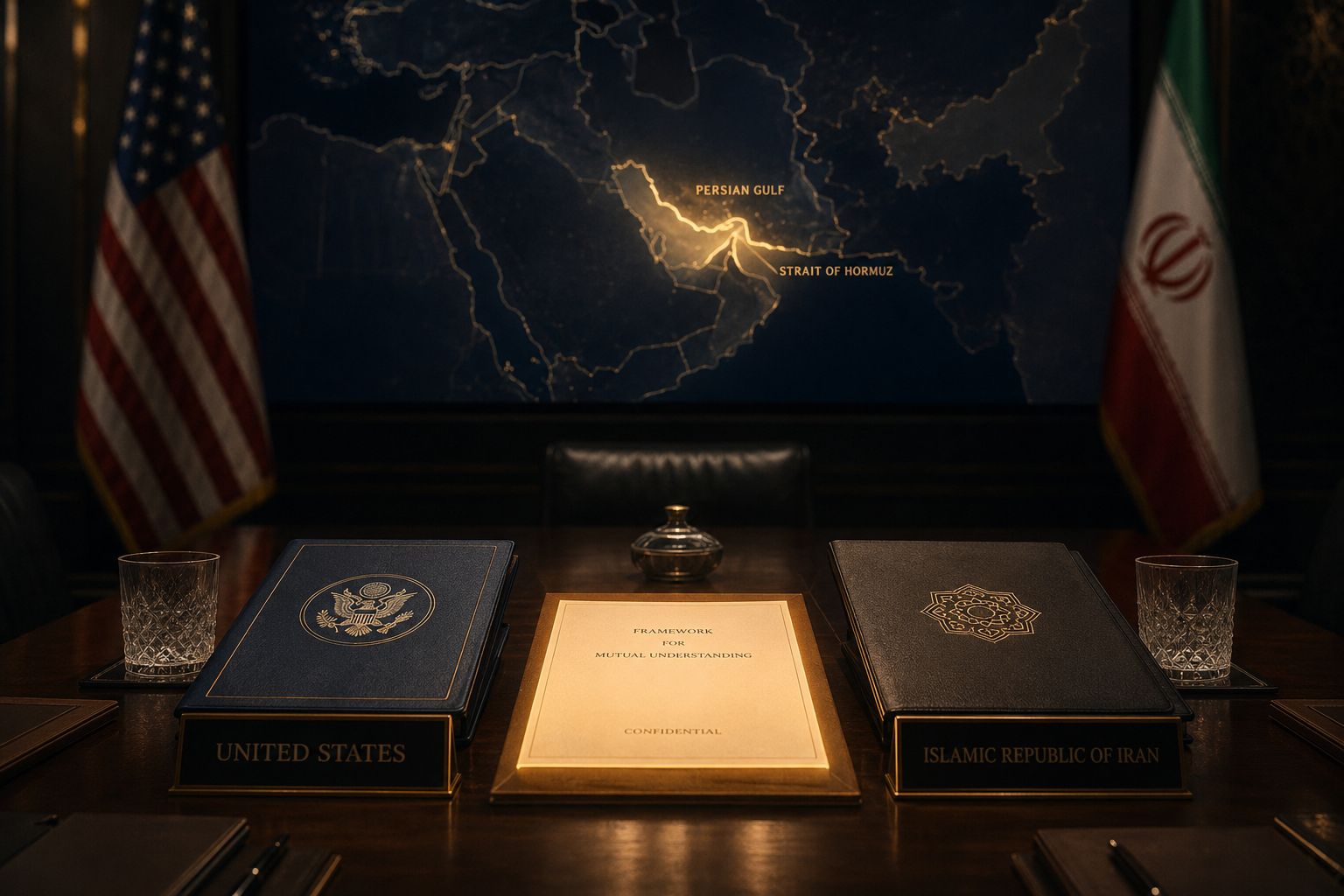
Iran and the US Are Nearing a Nuclear MOU — Here Is What Is Actually on the Table
Introduction
After weeks of near-misses, a Memorandum of Understanding between Iran and the United States now appears to be within reach. According to senior analysts tracking the negotiations closely, the past 48 hours of diplomatic activity suggest both sides have converged enough on a framework to move forward — even if a final, binding deal remains weeks or months away.
This is not a done deal. But the structure of what is being agreed upon, and more importantly what the Trump administration has quietly conceded, tells a significant story about how much has changed since the conflict began.
Quick Summary
The Iran-US talks are heading toward an MOU — a pre-agreement framework — not a final deal. Key elements include the unfreezing of $12–24 billion in Iranian assets, a negotiated reopening of the Strait of Hormuz, limits on Iran's nuclear enrichment with a 12–15 year sunset clause, and a ceasefire in Lebanon as a precondition set by Tehran. The deal, in broad shape, resembles the 2015 JCPOA that Trump himself abandoned.
What Is an MOU and Why Does It Matter Here?
Before getting into the substance of the talks, the terminology matters. What is being discussed right now is a Memorandum of Understanding, not a treaty or a final agreement.
An MOU establishes a shared framework — a set of agreed principles and boundaries within which all future negotiations will take place. Think of it as two parties agreeing on the shape of the table before they sit down to negotiate the actual terms. The granular details, the legal language, the verification mechanisms — all of that comes after the MOU is signed.
Why does this distinction matter? Because both sides can present an MOU as progress without committing to the points they still disagree on. It gives political cover while keeping negotiations alive.
What's on the Table: The Core Terms
Iran's Frozen Assets
One of the most concrete elements under discussion is the unfreezing of Iranian assets currently held under US sanctions. Estimates vary: some analysts put the figure at $12 billion, others at $24 billion. Whatever the final amount, the release of these funds appears to be a near-settled point. It is effectively the economic foundation of any agreement.
The Strait of Hormuz: A Quietly Major Issue
This is where the strategic dimension of the talks becomes clearest. Iran has been imposing a de facto blockade on the Strait of Hormuz, and international shipping has been caught in the middle. Ships have been trying to transit with transponders turned off, with American naval escort — and still being targeted by missile strikes. The commercial calculus is simple: no shipping company wants to risk its cargo on an active conflict route.
The US is negotiating for the Strait to return to its pre-war status. Iran, however, is pushing for something new: not a formal toll, but a "fee" framed around environmental protection and security services it claims to provide in the waterway. Washington publicly rejects this framing. But privately, the fact that it is even being discussed suggests the US has less leverage here than it would like to admit.
Nuclear Enrichment and the Sunset Clause
This is the most sensitive part of the negotiations. The US originally demanded zero enrichment — a permanent, unconditional halt to Iran's nuclear program. That position has quietly eroded.
What is now being discussed is a suspension of enrichment for a fixed period, with current discussions suggesting somewhere between 12 and 15 years, after which a sunset clause would allow Iran to resume. Iran will not agree to a permanent zero-enrichment arrangement. It has made that unambiguous.
Trump made a notable concession this week, acknowledging in an interview that de-enrichment conducted inside Iran — rather than a full transfer of material — could be acceptable. That is a significant shift from the opening position.
Highly Enriched Uranium: The Remaining Flashpoint
Iran possesses stockpiles of highly enriched uranium. The US wants them transferred to American custody. Iran has flatly refused. Its counter-proposal is to transfer portions to a third country — Russia was the recipient in the original JCPOA arrangement — or to keep the material inside Iran under IAEA supervision with enrichment levels reduced. Trump posted on Truth Social demanding the material be handed to the US; Tehran rejected this the same day. This remains an unresolved point.
Sanctions Relief
Iran is demanding the removal of both primary and secondary sanctions — not just an executive waiver, but legislative action through Congress. This is a harder ask than the JCPOA required, and it reflects Tehran's core lesson from 2018: an executive-level deal can be torn up by the next administration. Iran wants structural, legally durable relief this time, not a presidential commitment that expires with the term.
Whether Trump can deliver congressional action on this remains genuinely uncertain.
Why Iran Has the Upper Hand This Time
When the current conflict began, the US entered with four stated objectives: regime change in Tehran, a reduction in Iran's missile range, an end to Iranian support for regional allies including Hezbollah and Ansar Allah, and zero nuclear enrichment.
None of those four objectives are on the negotiating table anymore.
The conversation has collapsed back to the nuclear question — exactly the ground Iran was always willing to defend. Every other demand has been quietly dropped. The fact that the Trump administration is now spending political capital defending an MOU framework is itself telling: administrations do not burn credibility on agreements they do not believe are achievable.
There is also an operational cost driving American urgency. Maintaining a large naval presence in the region costs billions of dollars per day. Warship maintenance cycles intensify in warm-water summer conditions. The US wants to draw down. The MOU gives it a diplomatic path to do so.
Lebanon and Hezbollah: The Condition Most People Are Missing
Iran has added a condition that has received less attention than it deserves: it will not sign any MOU until there is a formal, lasting ceasefire in Lebanon. This links the Iran-US nuclear track directly to the Lebanese front and to Hezbollah's status — making the deal considerably more complex than it appears on the surface.
This is not a procedural demand. It is Iran signalling that it will not decouple its regional posture from its bilateral negotiations with Washington.
Is This Just JCPOA 2.0?
In broad terms, yes. The structure emerging from these talks — limited enrichment, IAEA oversight, sanctions relief in exchange for verified restrictions, a sunset clause — mirrors the architecture of the 2015 Joint Comprehensive Plan of Action that the Obama administration negotiated and Trump unilaterally withdrew from in 2018.
The irony is not subtle. The administration that called the JCPOA the worst deal in history appears to be negotiating its way back to something structurally similar, from a weaker strategic position than the one America held in 2015.
What Happens Next
If the MOU is signed, both sides have agreed to a 60-day window for formal nuclear negotiations. The MOU itself will also include a ceasefire, a US military drawdown from the region, and the unfreezing of Iranian assets.
Whether those 60 days produce an agreement depends on three unresolved questions: what happens to the highly enriched uranium stockpile, whether Congress can be moved on sanctions, and whether the Lebanon ceasefire holds long enough to keep Iran at the table.
The situation could still collapse. Both sides could walk back. But the gap between the two positions has narrowed considerably — and the diplomatic signals of the past 48 hours suggest that both parties believe a framework agreement is achievable.
FAQ Section
Q: What is the Iran-US MOU about? It is a Memorandum of Understanding — a preliminary framework agreement — that would define the terms within which formal nuclear negotiations will proceed. It is not a final deal, but a structural commitment to reach one.
Q: How much of Iran's frozen money could be released? Estimates range between $12 billion and $24 billion. The exact figure remains undisclosed, but the release of these funds appears to be among the more settled points in the current talks.
Q: Will Iran stop nuclear enrichment under this deal? Iran is unlikely to agree to permanent zero enrichment. Current discussions suggest a suspension for 12 to 15 years, after which a sunset clause would allow enrichment to resume. Iran views this as a hard red line.
Q: Why is the Strait of Hormuz part of a nuclear deal? Because the Hormuz blockade is one of the most immediate economic and military pressure points. The US is negotiating its removal as part of the broader package. Iran, in turn, is seeking fees for shipping access — a demand Washington publicly rejects but has not formally ruled out.
Q: How does this compare to the original JCPOA? Structurally, it is very similar — enrichment limits, IAEA monitoring, sanctions relief, and a sunset clause. The key difference is that Iran is now demanding more durable sanctions relief, including congressional action, to prevent a repeat of the 2018 withdrawal.
Q: What does Iran want regarding Lebanon? Iran has made a formal Lebanon ceasefire a precondition for signing any MOU. It will not separate the nuclear track from the regional conflict track.